You fall asleep just fine. Maybe even quickly.
Then somewhere around 3am, your eyes open. No alarm. No noise. Just awake. Mind already running before you've even moved.
You check the time. 3:06am.
You try to relax. Deep breaths. Flip the pillow to the cold side. Tell yourself to stop thinking, which of course makes you think harder. Eventually you drift off around 5am. Your alarm goes off at 6:00.
The rest of the day is a write-off. Coffee barely works. You snap at people over nothing. By 8pm you're exhausted, but when your head hits the pillow... wired again.
If this sounds like your life, you're not broken. There's a specific reason this happens. And almost nobody explains it properly.
Your brain runs a night shift
Sleep isn't one long block of unconsciousness. Your brain cycles through phases every 90 minutes, and each one does something different.
The first half of the night is mostly deep sleep. Physical repair. Immune system rebuilding. Your brain flushing out the day's waste.
The second half shifts toward lighter sleep and REM. Memory. Emotional processing. Cognitive restoration.
Between these two halves, roughly 3 to 4 hours after you fall asleep, there's a transition point. Your stress hormone cortisol starts rising toward morning. Your blood sugar can dip low enough to trigger a small stress response.
If your system is running smoothly, you glide through this without noticing. But if your nervous system is already running hot from chronic stress or mineral depletion, this transition wakes you up.
That's your 3am. It's not random. It's not "just anxiety." It's a biological handoff that your body isn't managing cleanly.
Why melatonin doesn't help
Melatonin doesn't improve sleep quality. It shifts the timing of when you feel sleepy. That's all it does.
If your problem is waking up at 3am, or sleeping 7 to 8 hours and still feeling wrecked, melatonin does essentially nothing for you.
This is why so many people try melatonin for a week, think it maybe helps a little, and then stop noticing. They were never missing the "fall asleep" signal. The problem was always somewhere else.
If you're waking up at 3am, melatonin isn't the answer. The problem is what happens during the night, not before it.
What actually decides if you wake up rested
Forget counting hours. Three things determine whether you wake up refreshed or wrecked.
1. Your nervous system state at bedtime. If your mind is racing when your head hits the pillow, your brain stays in alert mode. You never drop into deep, restorative sleep.
2. Your brain's fuel reserves. Sleep is active work. Your brain burns through magnesium, zinc, and B vitamins to run nightly repairs. Stress depletes these minerals fast. If you lack these raw materials, the repair work simply doesn't happen.
3. Your ability to handle the mid-night transition. This is the root of the 3am problem. A calm, well-fuelled nervous system glides through the shift. A stressed, depleted one panics and wakes you up.
You can have perfect sleep habits and still sleep poorly. Because your body lacks what it needs.
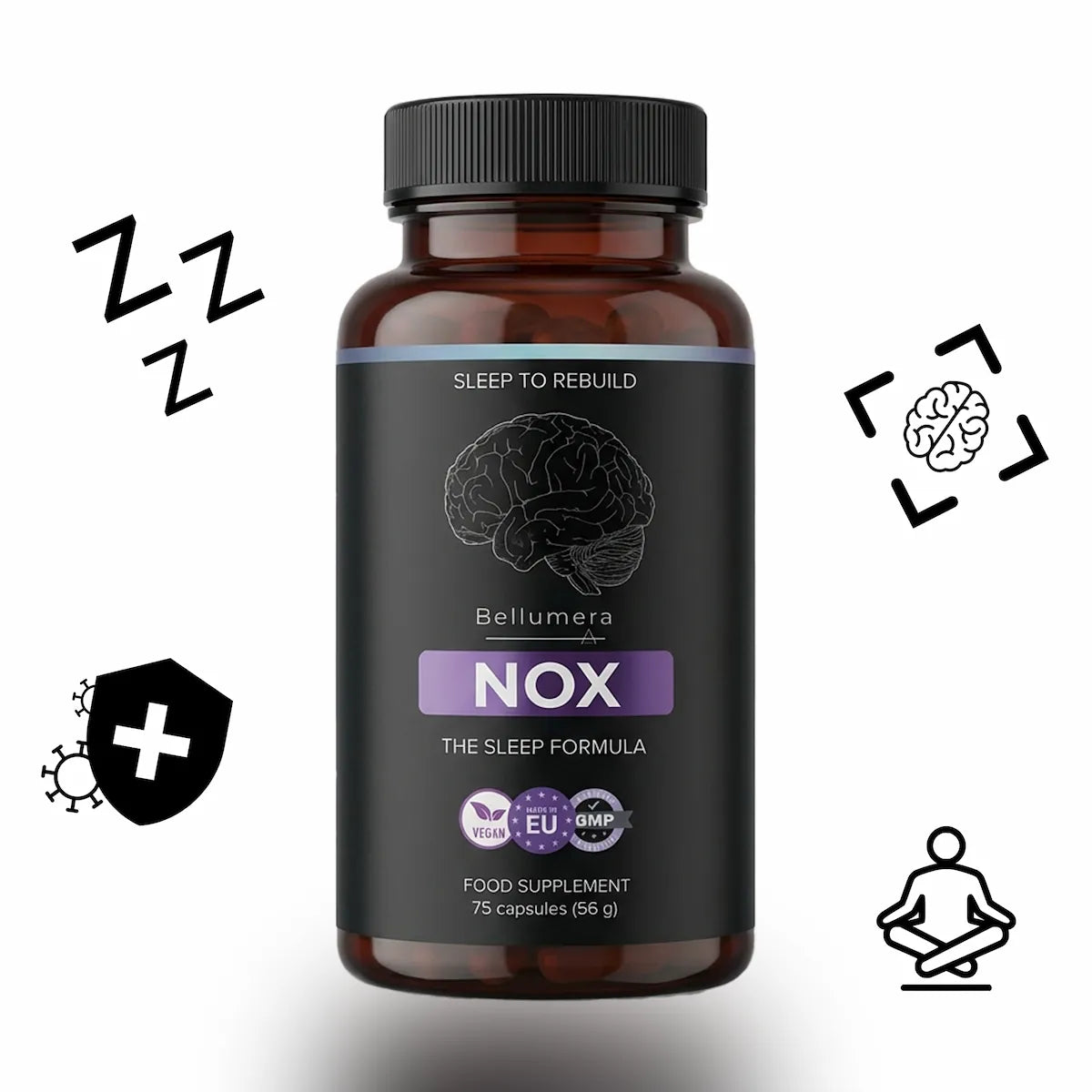
This is why we built NOX
The 3am wake-up isn't one problem. It's three: a nervous system that won't switch off, depleted minerals, and a biological transition your body can't handle smoothly. Most sleep supplements only address the first one.
NOX addresses all three. 11 compounds. Each one at a dose backed by research.
Calm your nervous system before bed. Saffron extract, Lemon Balm, and Myo-inositol support your body's natural relaxation. Not through sedation. Through genuine calm.
Stay asleep through the 3am transition. Valerian root helps you stay in deeper sleep phases instead of popping awake at every cycle. Reishi mushroom helps your body manage stress responses while you're unconscious.
Give your brain the fuel it needs. Magnesium Bisglycinate, Zinc, Vitamins C and E, and Selenium. The raw materials for overnight repair and protection.
No melatonin. No grogginess. No dependency.
What to expect
Night 1 to 3: Your mind is calmer at bedtime. You fall asleep faster.
Night 7 to 14: The 3am wake-ups become less frequent. You sleep through more nights.
After night 14: You start waking up before your alarm. Morning energy is real, not something you have to force with coffee.
What people are saying
⭐⭐⭐⭐⭐ "I used to dread bedtime because my thoughts wouldn't stop. Now my mind is actually quiet." — Mila B. 🇭🇷
⭐⭐⭐⭐⭐ "The 3am wake-ups are gone. I didn't think that was possible without medication." — Lars V. 🇳🇱
⭐⭐⭐⭐⭐ "The mornings changed everything. When you start the day rested, everything else follows." — Clara B. 🇩🇪
First time? Use code ZZZ for 10% off
Apply at checkout · Valid on your first order