This might be unpopular, but it needs to be said.
Melatonin is the most popular sleep supplement in Europe. You can find it in every pharmacy, every health store, every online shop. Gummy versions come in flavours like "blueberry dream" and "midnight cherry." Millions of Europeans take it every night.
There is a good chance you have tried it. There is also a good chance it didn't really work — or it worked for a few days, then stopped.
That's not a coincidence. And it's not because you bought the wrong brand or took the wrong dose. The problem is more fundamental: melatonin does not do what most people think it does.
What melatonin actually is
Melatonin is a hormone. Not a vitamin. Not a mineral. Not a herb. A hormone, produced by the pineal gland in your brain, that regulates the timing of your sleep-wake cycle.
When the sun goes down and light levels drop, your pineal gland starts releasing melatonin. This signals to your body: "It's time to prepare for sleep."
That's it. It's a timing signal. A biological clock setter.
Melatonin does not make you sleep deeper. It does not improve sleep quality. It does not help your brain perform repair work, consolidate memories, or clear metabolic waste. It does not reduce the time you spend awake in the middle of the night.
This makes melatonin genuinely useful for one thing: resetting your circadian rhythm. If you flew from Berlin to Tokyo and your body clock is 8 hours off, melatonin can help shift it back. That's the use case the research strongly supports.
For everything else — the 3am wake-ups, the shallow sleep, the mornings where you feel like you barely rested — melatonin addresses the wrong part of the problem.
The quality vs. timing problem
Think of it this way. Your brain has two separate systems for sleep.
The timing system tells you when to sleep and when to wake. Melatonin is the key signal here. This system answers the question: "Is it time to sleep?"
The quality system determines how deep you sleep, how long you stay in each stage, how effectively your body repairs itself overnight. This system is governed by GABA activity, cortisol levels, mineral availability, nervous system state, and a dozen other factors. This system answers the question: "Is this sleep actually doing its job?"
For most adults with sleep complaints, the timing system is working fine. You feel tired at night. You can fall asleep (even if it takes a while). The problem is what happens after — shallow sleep, frequent awakenings, morning exhaustion despite adequate hours.
Throwing melatonin at a quality problem is like adjusting the clock on a broken machine. The time might be right, but the machine still doesn't work.
Why it seems to work at first
Many people report that melatonin helps for the first few nights. This is real, but the reason is often misunderstood.
When you take supplemental melatonin, you get a much stronger timing signal than your body normally produces. If your natural melatonin production was slightly delayed (from late-night screen use, irregular schedules, or stress), the supplement corrects this — and you fall asleep faster.
But "falling asleep faster" and "sleeping better" are not the same thing.
After a few nights, your body adjusts to the external dose. The initial effect fades. Some people increase the dose. Others switch brands. The pattern continues: short-term improvement, followed by a return to the same underlying problem.
Because the underlying problem was never about the timing signal.
The dependency question
Here is where it gets more concerning.
Melatonin is a hormone, not a nutrient. Unlike vitamins or minerals, hormones work within a tightly regulated feedback system. When you consistently add melatonin from outside, your body may reduce its own production over time. Your pineal gland senses elevated melatonin and decreases its own output.
This creates a subtle dependency. Not the dramatic withdrawal you'd get from prescription sleep medication, but a gradual reliance where your natural melatonin production diminishes and you start needing the supplement to achieve what your body used to do on its own.
Many long-term melatonin users report needing higher doses over time, or feeling worse when they stop. This is consistent with what we'd expect from hormonal down-regulation. The research on this is still ongoing and not all experts agree on the extent, but the mechanism is plausible and consistent with how other hormonal feedback systems work.
The dose problem
Your pineal gland produces roughly 0.1 to 0.3 mg of melatonin per evening. The typical supplement dose? 3-10 mg. That's 10 to 100 times what your body produces naturally.
At these doses, melatonin isn't acting as a gentle timing signal. It's flooding your system with a hormone at levels your body was never designed to handle nightly. This is why so many people experience morning grogginess, vivid or disturbing dreams, headaches, and that foggy "hungover" feeling the next day. You fall asleep slightly easier, but you wake up heavy and slow to start. You traded one problem for another.
EU regulators take this seriously. Melatonin regulation varies across the European Union. Several countries require a prescription for doses above 1 mg. This reflects how seriously regulators treat the fact that melatonin is a hormone, not a simple supplement.
The gummy problem
This is worth mentioning because gummy supplements have become enormously popular.
The gummy format limits what a formula can contain. To make something taste like "blueberry dream," you need sugar, flavouring, colouring, and gelling agents. These take up space in the formula and add complexity to the manufacturing process.
The result: gummy sleep supplements typically contain melatonin and very little else of value. Maybe a small amount of one herb at a sub-effective dose. The format literally prevents a comprehensive formula.
This is not a coincidence. Melatonin-based gummies are cheap to produce and easy to market. They taste good. They feel friendly. They sell extremely well. Whether they actually improve your sleep in a meaningful way is a different question.
When melatonin does make sense
For completeness and honesty: melatonin is not useless. It has legitimate applications.
Jet lag recovery. Short-term use (3-5 days) to reset circadian timing after crossing time zones is well-supported by research.
Delayed sleep phase. If you naturally don't feel sleepy until 2-3am and need to shift earlier, low-dose melatonin (0.3-0.5 mg) taken 2-3 hours before desired bedtime can help gradually move your timing window.
Shift work adjustment. People rotating between day and night shifts can use melatonin strategically to manage circadian disruption.
Notice the pattern: these are all about timing. And they're all short-term. If your problem is what happens during sleep — the quality, the depth, the mid-night wake-ups, the unrestorative hours — melatonin misses the point entirely.
The alternative: support the quality system
If melatonin addresses the "when" of sleep, the real question is: what addresses the "what"?
The answer starts with understanding what your body actually does during sleep and what it needs to do that work well. (We wrote a detailed guide on this: What Happens to Your Body While You Sleep, Hour by Hour.)
Nervous system state at bedtime. If your mind is still active when you fall asleep, you stay in light sleep patterns longer and miss the deep phases. Supporting your GABA system — your brain's natural calming mechanism — helps your nervous system genuinely downshift rather than just become drowsy. Compounds like saffron extract and lemon balm work through GABA and serotonin modulation — not sedation, but actual calming of neural activity.
Raw materials for overnight repair. Your brain burns through magnesium, zinc, and other minerals to perform the maintenance work that sleep exists for. Chronic stress depletes these rapidly. Without adequate reserves, your body has the time but not the tools.
Sleep continuity. Staying in deep sleep through the night, especially through the vulnerable transition point around 3-4 hours in (the mechanism behind the 3am wake-up), requires sustained nervous system support. Adaptogens like reishi and herbs like valerian work on the mechanisms that keep sleep deep and continuous.
This is a fundamentally different approach from the melatonin model. Instead of overriding one signal, you're supporting the entire system that determines whether your sleep actually does its job.
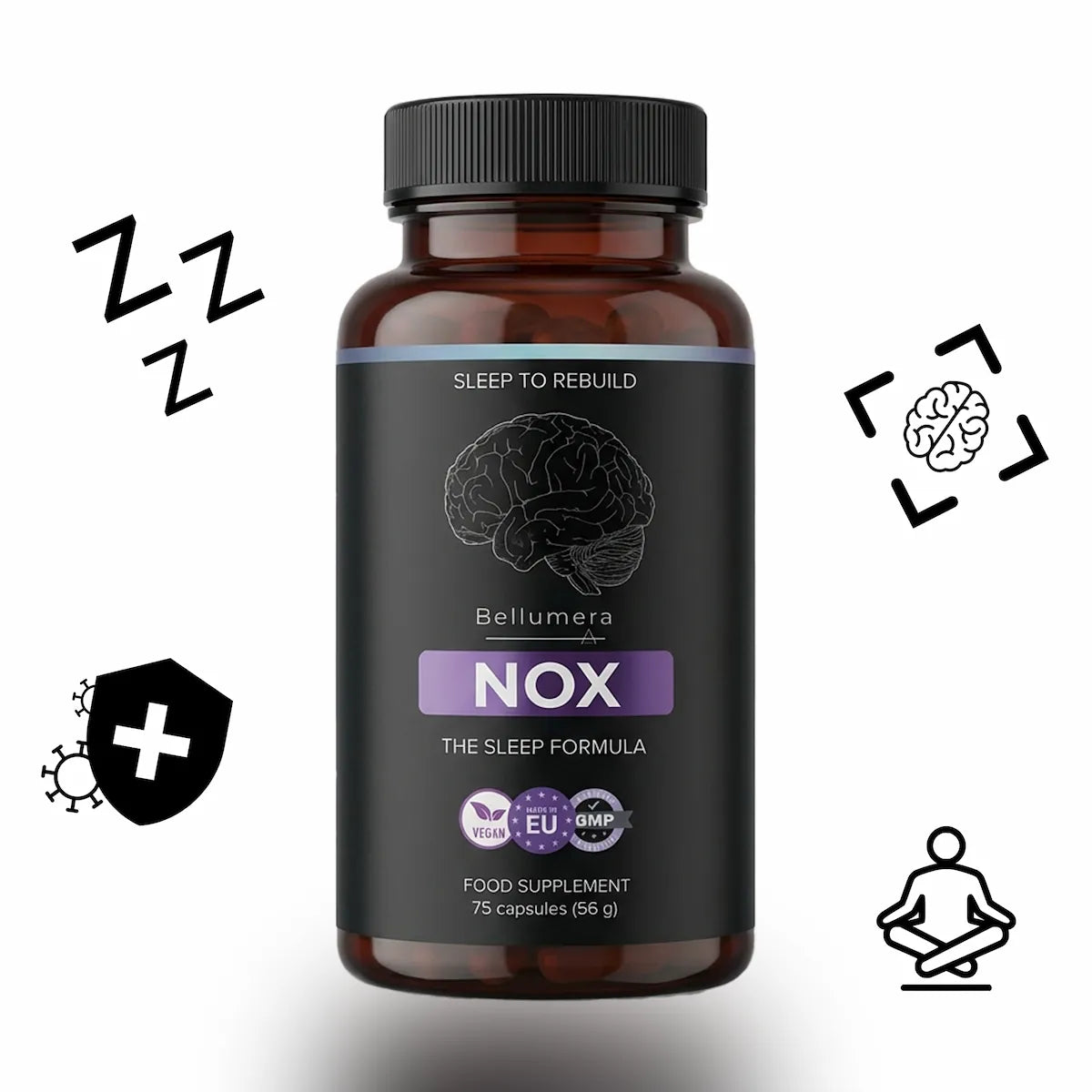
Why NOX contains zero melatonin
This is a deliberate choice, not a limitation.
NOX was designed around a simple principle: support what your body does during sleep, not just the signal that starts it.
Affron® saffron extract and Lemon Balm support GABA and serotonin activity — helping your nervous system calm down naturally. Myo-inositol amplifies this calming effect. Valerian root supports sleep maintenance through the night — the continuity that melatonin does nothing for. Reishi mushroom helps manage the stress responses that cause mid-night wake-ups and fragmentation.
Magnesium Bisglycinate and Zinc replenish the raw materials your brain needs for overnight repair. Vitamins C and E plus Selenium protect your cells during the intensive repair process. Black pepper extract ensures your body actually absorbs all of it.
11 compounds. Each one addressing a specific part of the sleep process. Each one at a dose backed by research.
Most people feel the calm and easier sleep onset within the first few nights. By night 7-14, the deeper effects build. Not because we've overridden your natural sleep chemistry with an external hormone — but because we've given your body what it needs to run its own systems properly.
Your body knows how to sleep. It might just need different support than what the bestseller shelf is offering.