Nobody warns you about this.
In your 20s, sleep was effortless. You could fall asleep on a couch at a party and wake up fine. In your 30s, maybe you noticed it took a bit longer to recover from a bad night. Annoying, but manageable.
Then somewhere around 40, something shifts. And it's not subtle.
You start waking up in the middle of the night for no reason. Mornings feel heavier. Afternoon energy disappears. You can't remember the last time you woke up actually feeling rested. You sleep the same number of hours but somehow get less from them.
Most people chalk this up to stress, work, kids, life getting busier. And those things play a role. But there's a biological explanation that almost nobody talks about, and understanding it changes how you approach the problem.
Your sleep architecture is literally restructuring
Starting in your mid-30s and accelerating through your 40s and 50s, the composition of your sleep changes at a physiological level.
The percentage of time you spend in deep sleep (stages 3 and 4, the slow-wave phases where physical repair and brain detoxification happen) decreases. Some research suggests that by age 50, you might be getting 50-60% less deep sleep than you did at 25.
You're not sleeping less overall. But the quality of that sleep has shifted toward the shallower end. More time in stages 1 and 2 (light sleep), less time in the deep phases where your body does its most important overnight work.
This explains why you can sleep 7.5 hours and feel worse than you did on 6 hours in your 20s. The hours are there. The depth isn't.
You're not sleeping worse because you're doing something wrong. Your body's sleep system needs different support than it did 10 years ago.
For women: the hormonal shift that nobody warns you about
If you are a woman between 40 and 58, there is likely a specific hormonal reason your sleep has changed. And it probably started before anyone used the word "menopause."
Progesterone declines first. This is one of the earliest hormonal changes during perimenopause, which can start in your early 40s, sometimes earlier. Progesterone has a direct calming effect on the nervous system — it enhances GABA activity, which is the neurotransmitter responsible for helping your brain switch off. As progesterone drops, your nervous system loses one of its primary tools for transitioning into deep sleep and staying there.
The result: your mind feels busier at bedtime. Not because you're more stressed than before, but because the chemical brake that used to quiet your thoughts is weakening.
Oestrogen fluctuates unpredictably. Before it eventually declines, oestrogen swings — sometimes high, sometimes low, sometimes different from one week to the next. This affects body temperature regulation (night sweats and hot flashes are the obvious symptoms) and serotonin production, which impacts both mood and melatonin synthesis. Even without obvious hot flashes, oestrogen instability causes more frequent micro-arousals — brief moments where your brain shifts to a lighter sleep stage before dropping back down.
You may not remember these micro-arousals. But each one partially resets your sleep cycle. Instead of completing full 90-minute cycles through deep sleep and REM, your brain keeps restarting. The result: 8 hours in bed, but fragmented, shallow sleep that doesn't restore you.
Research confirms this pattern. Over 50% of women going through the menopausal transition report significant sleep disturbances. Not just difficulty falling asleep — the specific pattern of sleeping long enough and still waking up exhausted.
This is not a personal failure. It's a biological shift that changes what your body needs in order to sleep well.
For men: the slow decline nobody talks about
Men's sleep changes are less dramatic but just as real.
Testosterone declines gradually. Starting around age 30, testosterone drops by roughly 1% per year. The effects are more gradual than the perimenopause transition, but by your mid-40s, the cumulative effect becomes noticeable. Lower testosterone is associated with reduced deep sleep duration, increased body fat (which raises sleep apnea risk), and lower overall sleep quality. Many men don't connect their declining sleep with hormonal changes because the decline is slow and steady rather than dramatic.
Growth hormone production drops. Your body releases most of its growth hormone during deep sleep. But as deep sleep decreases, growth hormone decreases too — creating a cycle where less deep sleep leads to less recovery, which leads to worse sleep quality overall.
Cortisol sensitivity increases. The mid-night cortisol rise that's supposed to be gentle becomes more abrupt. This is the biological mechanism behind the 3am wake-up that becomes increasingly common for men in their 40s. Your body interprets a normal hormonal shift as a stress signal and pulls you into full alertness.
The practical effect: you still fall asleep reasonably well, but your sleep architecture deteriorates. Less deep sleep. More fragmentation. Mornings where you feel like you ran a marathon in your sleep instead of recovering from the day.
For everyone: the quiet depletion
Regardless of sex, natural melatonin production decreases with age. Your pineal gland calcifies over time (a well-documented phenomenon), producing less melatonin each year. This doesn't mean you can't sleep — it means the timing signal gets weaker, and the onset of sleepiness in the evening becomes less decisive.
Meanwhile, decades of stress, caffeine, alcohol, and demanding careers take a cumulative toll on your magnesium, zinc, and B-vitamin stores. These are the raw materials your brain uses during sleep for repair work. If you were marginally depleted in your 30s, you're probably more so in your 40s.
And cortisol patterns shift for everyone. The evening decline that should prepare you for sleep may become less pronounced, especially under chronic stress. The combination of weaker melatonin signalling and higher evening cortisol makes the transition into sleep harder and the descent into deep sleep shallower.
Why the standard advice stops working
Cool bedroom. No screens. Consistent schedule. Limit caffeine.
This advice is valid. It helps. But it was designed for a body that isn't going through these changes.
The sleep hygiene recommendations assume your underlying sleep architecture is healthy and you're just interfering with it through bad habits. After 40, the architecture itself is changing. You need to support the biology, not just remove the obstacles.
And yet most sleep products on the market are still just melatonin. Your melatonin production is already declining. Supplementing with it addresses the timing signal, but it doesn't restore the deep sleep percentage, calm the nervous system, or replenish the minerals your brain is burning through at night. (We wrote about this in detail: Melatonin: Making Things Worse?)
The mismatch between what your body needs after 40 and what the sleep market offers is enormous.
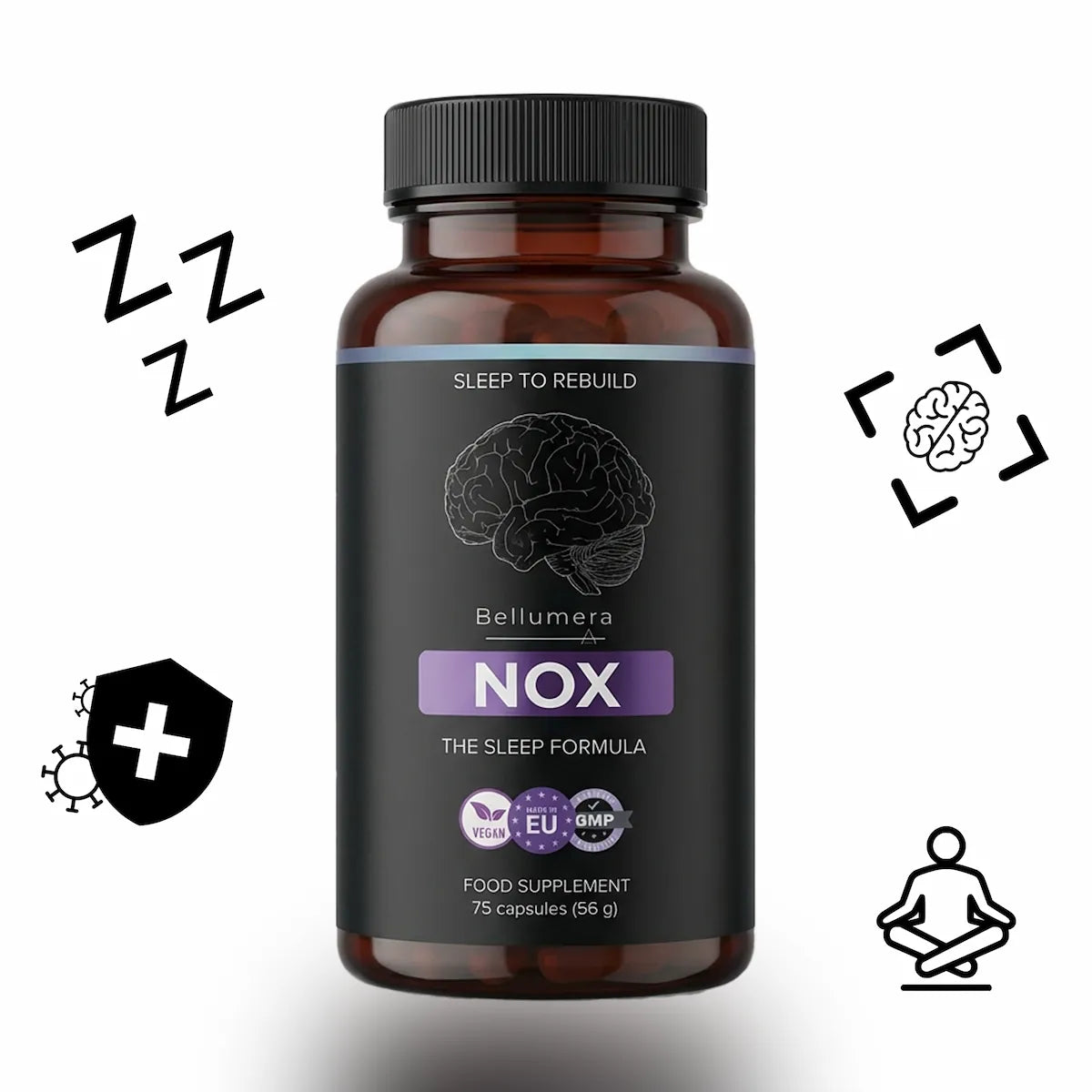
This is exactly what NOX was designed for
We didn't build NOX for 25-year-olds who sleep fine but want to optimise. We built it for the person whose sleep changed somewhere around 38, 42, 46 — and who has tried everything the internet recommends without getting back to where they were.
Affron® saffron extract and Lemon Balm support the GABA activity that declines with hormonal shifts — helping your nervous system find the calm that used to come naturally. Myo-inositol amplifies this effect. These aren't sedatives — they're supporting a system that's running with less hormonal backing than it used to have.
Magnesium Bisglycinate — one of the most bioavailable forms, well-absorbed and gentle on the stomach — replenishes the mineral your brain uses most during sleep. Zinc supports neurotransmitter metabolism and overnight immune repair. These are the raw materials that decades of stress have steadily depleted.
Valerian root supports sleep continuity through the night. Reishi mushroom helps manage the stress responses that cause fragmentation and early waking. Together, they protect your sleep architecture during the vulnerable transitions that become more difficult with age.
Vitamins C and E plus Selenium protect your cells during the intensive overnight repair work. The repair processes that happen during deep sleep generate oxidative stress as a byproduct — antioxidant support during this window helps protect cells while the work gets done. Black pepper extract ensures your body actually absorbs all of it.
11 compounds. Each one at a dose backed by research. No melatonin — because melatonin shifts when you feel sleepy, and that was never your problem.
Most people notice a calmer mind and easier sleep onset within the first few nights. By night 7-14, the deeper effects build. Sleep starts feeling like sleep again — not just time spent in bed hoping something happens.
The bigger picture
Here's what frustrates us about how we talk about ageing and sleep.
We treat declining sleep quality after 40 as inevitable. "You're getting older, what do you expect?" As if deteriorating recovery, disappearing energy, and brain fog are just the price of admission to middle age.
They're not. They're the price of not adapting your approach as your biology changes. Nobody expects to eat the same diet at 45 that they ate at 22 and have the same body. So why do we expect to do nothing different about sleep and get the same results?
Your sleep system at 42 is different from what it was at 28. It has different needs, different vulnerabilities, different bottlenecks. Meeting it where it is — not where it used to be — is the difference between ageing feeling like decline and ageing feeling like a different chapter.
The energy, the focus, the resilience, the feeling of actually being rested — it's still available. Your body still knows how to do it. It might just need more support than it used to.