You went to bed at a reasonable time. You didn't wake up during the night (or maybe only once). Your alarm went off after a solid 7 or 8 hours.
And yet.
You feel like you barely slept. Heavy eyes. Foggy thinking. That feeling where your body is technically awake but your brain hasn't fully arrived yet. You stand in the kitchen staring at the coffee machine, waiting for it to do the work your sleep was supposed to do.
This isn't laziness. This isn't "just getting older." And it's not something you should accept as normal.
If you regularly sleep 7-8 hours and still wake up tired, something specific is going wrong during your night. The good news: once you understand what it is, you can address it.
The difference between sleeping and recovering
Here's what most people don't realise: your body doesn't treat all sleep the same.
Lying in bed for 8 hours is not the same as 8 hours of effective sleep. Your brain cycles through different phases — light sleep, deep sleep, and REM — and each one performs a different function. Deep sleep handles physical repair. REM handles memory and emotional processing.
The quality of these phases matters far more than the total number of hours.
You can spend 8 hours in bed and get only 45 minutes of true deep sleep (instead of the 90-120 minutes your body needs). The result: you slept "enough" by the clock, but your body didn't complete its repair work. You wake up feeling like you're running on yesterday's energy — because you are.
Three reasons your sleep isn't restoring you
1. You're falling asleep in the wrong state.
If your nervous system is still active when you fall asleep — from stress, from screens, from a mind that won't stop planning tomorrow — your brain doesn't drop into deep sleep efficiently. Instead, it stays in light sleep patterns for too long.
You're technically asleep. But your brain is doing surface-level work when it should be doing deep maintenance.
Think of it this way: imagine arriving at a workshop, but the lights are only at 30%. You can see enough to move around, but you can't do precision work. That's what light sleep is — present but not productive.
The fix isn't sedation. Sleeping pills and high-dose melatonin can make you unconscious faster, but they don't improve the quality of what happens after you fall asleep. In some cases, they actually reduce deep sleep time.
2. Your body lacks the raw materials for repair.
Sleep isn't passive. It's one of the most metabolically active periods of your day. Your brain and body are performing serious work: clearing waste, repairing tissue, consolidating memories, producing immune cells, managing inflammation.
All of this requires specific nutrients. Magnesium is involved in over 300 enzymatic processes, many of which are active during sleep. Zinc supports immune function and cellular repair. B vitamins contribute to energy metabolism and nervous system function.
Here's the problem: chronic stress depletes these minerals rapidly. And modern diets — even good ones — often fall short of optimal levels. Studies across EU countries show that a significant portion of adults don't meet recommended daily intakes for magnesium and zinc.
Without these raw materials, your body starts the night shift understaffed. The work doesn't get done. You wake up with the bill unpaid.
3. Your sleep architecture is fragmented.
Even if you don't remember waking up, your sleep may be breaking apart throughout the night in micro-arousals — brief moments where your brain shifts to a lighter state before dropping back down.
Each micro-arousal resets your sleep cycle. Instead of completing a full 90-minute cycle of deep sleep and REM, your brain keeps restarting from the beginning. You end up with plenty of light sleep and not enough of the deeper, restorative phases.
Common causes:
Cortisol dysregulation — your stress hormone rises too early or too sharply during the night, pulling you toward wakefulness. (This is also the mechanism behind the 3am wake-up — the same problem, just more severe.)
Blood sugar instability — a dip in blood sugar can trigger a small adrenaline response, enough to fragment your sleep without fully waking you.
Mineral depletion — magnesium and zinc play direct roles in nervous system regulation. Low levels make your system more reactive to normal nighttime hormonal shifts.
You don't need more sleep. You need sleep that actually works.
Why this gets worse after 40
If you're reading this and thinking "this started a few years ago — I used to sleep fine," there's a reason for that.
Starting in your late 30s and accelerating through your 40s, your body produces less of the hormones that directly support deep sleep. Oestrogen and progesterone both play a role in nervous system regulation and sleep architecture. As their levels shift — particularly during perimenopause — your sleep becomes more fragile even if nothing else in your life has changed.
Progesterone is calming. It supports GABA activity in the brain, which is your body's natural "slow down" signal. As it declines, your nervous system loses one of its key tools for transitioning into deep sleep and staying there.
Oestrogen helps regulate body temperature and serotonin production, both of which influence sleep continuity. When it fluctuates, the result is more frequent micro-arousals, lighter sleep phases, and that familiar pattern of sleeping "enough" but never feeling restored.
Research confirms this: over 50% of women going through the menopausal transition report significant sleep disturbances. Not just difficulty falling asleep — but the specific pattern of sleeping long enough and still waking up exhausted.
This isn't something wrong with you. It's a biological shift that changes what your body needs in order to sleep well. The three factors we described above — nervous system state, mineral reserves, and sleep architecture — all become more important during this transition, not less.
The standard advice (cool bedroom, no screens, consistent schedule) helps, but it was designed for a body that isn't going through these changes. Supporting your sleep at this stage means giving your body the specific raw materials and nervous system support it now needs more than ever.
Why the standard advice falls short
You've probably heard all the usual recommendations. Cool bedroom. No screens before bed. Consistent schedule. Avoid caffeine after noon.
These are all valid. They all help. But for many people, they're not enough.
If your nervous system is chronically activated and your mineral reserves are low, no amount of sleep hygiene can compensate for what your body is missing. You can have the perfect bedtime routine and still wake up tired because the biological machinery of sleep doesn't have what it needs to function.
This isn't a motivation problem. It's a supply problem.
The gap between sleeping and recovering
The "8 hours but still tired" problem is a supply problem. Your body has the time. It doesn't have the materials.
Most sleep supplements focus entirely on falling asleep. Melatonin shifts your circadian timing. Antihistamines sedate you. None of them address what happens after you're already asleep.
If your deep sleep isn't restoring you, the fix starts with raw materials. Magnesium Bisglycinate — one of the most bioavailable forms, well-absorbed and gentle on the stomach — is directly involved in GABA receptor function where sleep quality is regulated. Zinc supports neurotransmitter metabolism and immune repair overnight. Without these, your brain simply can't execute the maintenance programs that deep sleep exists for.
Then there's the fragmentation problem. Micro-arousals keep resetting your sleep cycles before they complete. Valerian root supports sleep continuity, helping you stay in deeper phases instead of bouncing back to the surface every 90 minutes. Reishi mushroom helps your body manage the stress responses that cause those micro-arousals in the first place.
And for the nervous system state that determines how quickly you drop into deep sleep: Affron® saffron extract and Lemon Balm support genuine relaxation through GABA and serotonin activity. Myo-inositol amplifies this. So your brain can access the deep phases faster instead of spending the first two hours in shallow patterns.
Vitamins C and E plus Selenium form an antioxidant chain that protects your cells during overnight repair — the intense work that generates oxidative stress as a byproduct.
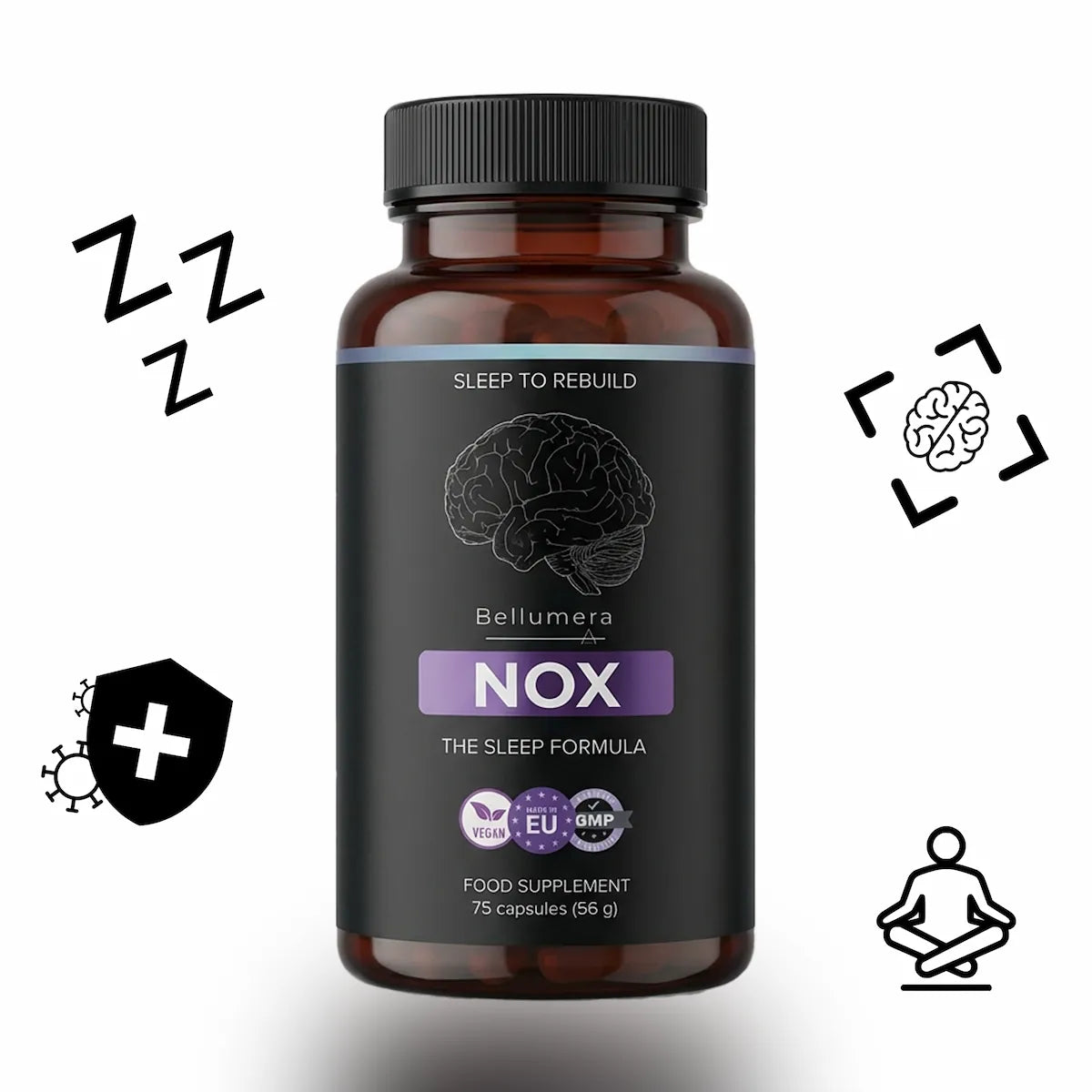
This is why we built NOX
11 compounds. Each one at a dose backed by research. Zero fillers, binders, or artificial additives. No melatonin.
NOX helps you fall asleep, yes. But more importantly, it supports what happens during those hours — the deep sleep phases, the uninterrupted cycles, the repair work that determines whether you wake up restored or just... awake.
Most people feel the calm and easier sleep onset within the first few nights. By night 7-14, the deeper effects build. You start waking up before your alarm. Your energy holds past 3pm. Morning brain fog lifts.
Not because you slept longer. Because your sleep started actually doing its job.