You set your alarm for 7:00. You get into bed at 23:00. That gives you 8 hours.
But what actually happens during those 8 hours? Most people think of sleep as one long pause. You close your eyes, time passes, you open them again. Nothing interesting.
That's completely wrong.
Your body runs a precise, timed sequence of repair work every single night. Each phase has a specific job. Miss one, and you feel it the next day — even if you technically slept "enough."
Here's what happens inside your body, hour by hour, from the moment you fall asleep.
23:00 – 00:00 | The Transition
Your body temperature drops. Your heart rate slows. Your brain starts producing longer, slower waves as it shifts from wakefulness into light sleep.
This first hour is preparation. Your muscles relax. Your breathing becomes regular. Your brain is still somewhat aware of your surroundings — this is why a small noise can still wake you easily during this window.
What matters here: the state of your nervous system at this moment determines how quickly you move into deep sleep. If your mind is still active from the day — stress, screens, unfinished thoughts — your brain stays in a shallow pattern longer. You lose valuable deep sleep time that can't be recovered later in the night.
00:00 – 02:00 | Deep Repair
This is the most physically restorative period of your entire night.
Your brain enters slow-wave sleep (sometimes called "deep sleep"). During this phase, your body releases the highest concentration of growth hormone — not for growing taller, but for repairing tissue, strengthening the immune system, and rebuilding muscle.
Your brain's waste clearance system (called the glymphatic system) becomes highly active. It flushes out metabolic waste that accumulated during the day, including proteins linked to cognitive decline. This cleaning process is up to 60% more efficient during deep sleep than during wakefulness.
Your blood pressure drops to its lowest point. Your cells repair DNA damage. Your immune system produces and distributes protective cells.
This phase depends on raw materials. Magnesium supports muscle and nerve relaxation. Zinc is involved in immune cell production. Without adequate levels of these minerals, your body simply can't perform these repair tasks at full capacity. It's like running a factory without supplies.
02:00 – 04:00 | The Critical Transition
This is where most sleep problems show themselves.
Around this time, your body shifts from deep sleep dominance toward lighter sleep and REM (rapid eye movement) phases. Your cortisol — the stress hormone — begins its slow rise toward morning. Your blood sugar may dip.
In a well-regulated body, this transition happens smoothly. You cycle through it without noticing.
But if your nervous system is under chronic stress, or if key minerals are depleted, this transition can trigger a wake-up. Your brain interprets the hormonal shift as a stress signal and pulls you into full alertness. This is the 3am wake-up that millions of people experience — and there's a specific biological reason behind it.
The 3am wake-up is not random. It's a biological transition that your body isn't managing smoothly.
04:00 – 06:00 | Memory and Emotion
The second half of the night is dominated by REM sleep — the phase most associated with dreaming.
REM isn't entertainment. It's essential maintenance. During this phase, your brain consolidates memories from the previous day, transferring important information from short-term to long-term storage. It processes emotional experiences, reducing their intensity so you can function clearly the next day.
Research shows that people who get insufficient REM sleep have measurably worse emotional regulation the following day. They react more strongly to minor frustrations, struggle with decision-making, and report higher levels of irritability.
Your REM periods get longer as the night goes on. The longest and most important REM cycles happen between 04:00 and 07:00. This is why cutting your sleep short by even one hour — waking at 6:00 instead of 7:00 — can have such a noticeable impact on your mood and mental clarity.
06:00 – 07:00 | Preparation for Waking
Your cortisol reaches its morning peak. Body temperature rises. Your brain shifts back toward faster wave patterns.
If your night went well — if each phase completed its work — you wake up naturally before your alarm. You feel clear. Your body feels recovered. You don't need 20 minutes and two coffees to feel human.
If your night didn't go well — if deep sleep was cut short, if you woke during the transition, if REM phases were fragmented — you wake up feeling heavy, foggy, and unrested. Not because you didn't sleep long enough, but because your sleep didn't do what it was supposed to do. (Sound familiar? Here's why you can sleep 8 hours and still wake up tired.)
Sleep quality isn't about hours. It's about what happens during those hours.
You can spend 8 hours in bed and wake up exhausted if your body couldn't complete its repair sequence. And you can sleep 7 hours and wake up sharp if every phase ran properly.
The difference comes down to three things:
1. A calm nervous system at bedtime — so your brain drops into deep sleep quickly instead of staying in a shallow pattern for hours.
2. Adequate mineral reserves — so your body has the raw materials to actually perform the repair work that deep sleep is designed for.
3. A smooth mid-night transition — so the shift from deep sleep to REM doesn't trigger a stress response that wakes you up.
Most sleep supplements only address the first point (helping you feel sleepy). They ignore the repair work and the mid-night transition entirely.
Every phase needs something different
11 compounds. Each one mapped to a specific phase of the sequence you just read about.
Affron® saffron extract, Lemon Balm, and Myo-inositol for the 23:00-00:00 transition — helping your nervous system drop into deep sleep faster instead of staying in shallow patterns. Magnesium Bisglycinate and Zinc for the 00:00-02:00 deep repair window — the raw materials your brain burns through during its most intensive maintenance work. Valerian root and Reishi mushroom for the 02:00-04:00 critical transition — keeping you in deeper phases through the cortisol shift instead of waking up. Vitamins C and E plus Selenium for cellular protection throughout the entire sequence.
Each dose backed by research. Zero fillers, binders, or artificial additives. No melatonin.
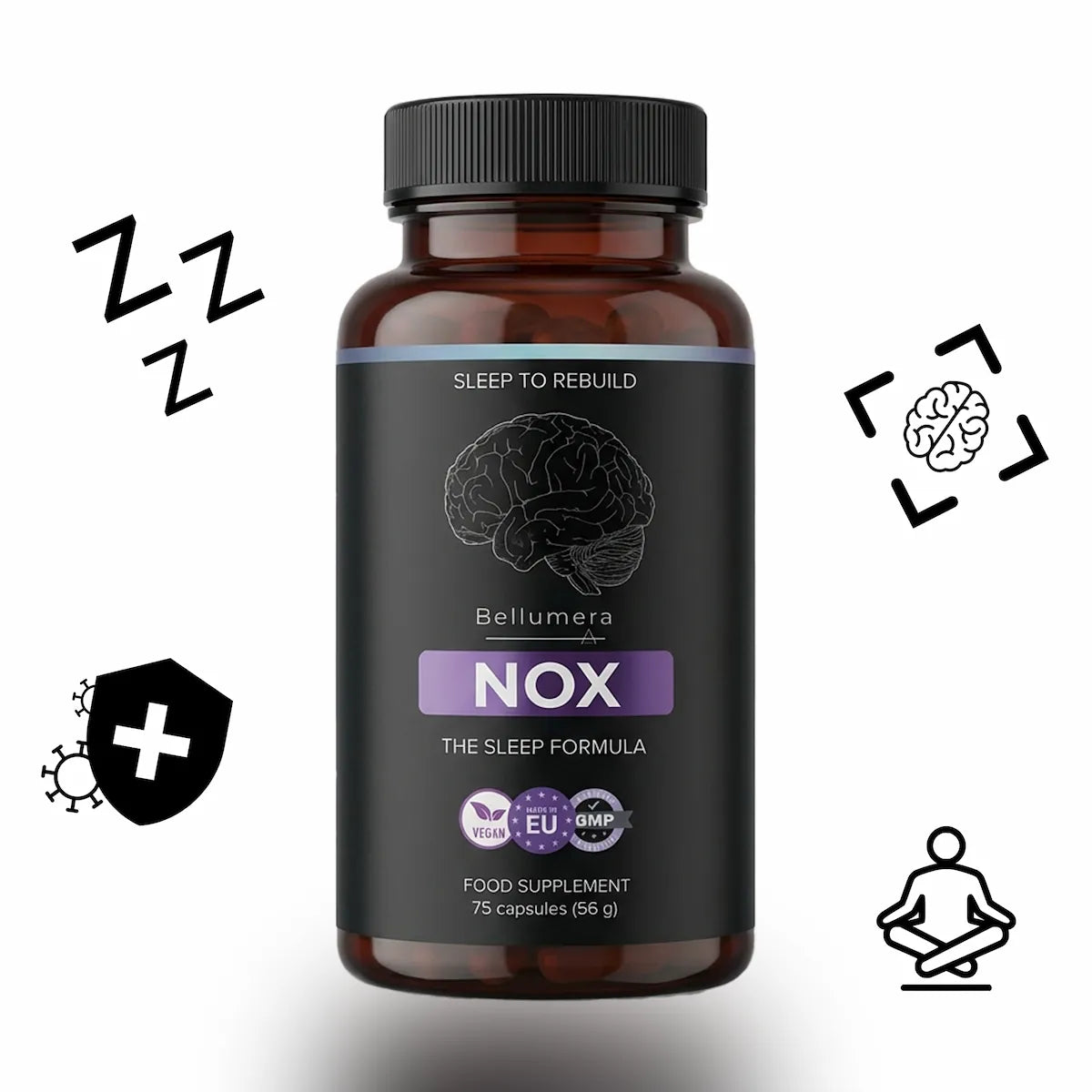
That's NOX. Not just a sleep aid — a formula designed around every hour of your night. From the moment your nervous system needs to let go, through the deep repair window, past the vulnerable 3am transition, and into the REM phases that sharpen your mind for tomorrow.
Most people notice a calmer mind and easier sleep onset within the first few nights. By night 7-14, the deeper effects build. Mornings that actually feel like mornings. Energy that lasts. Focus that holds.
Because as you now know — the hours were always there. They just weren't being used well.